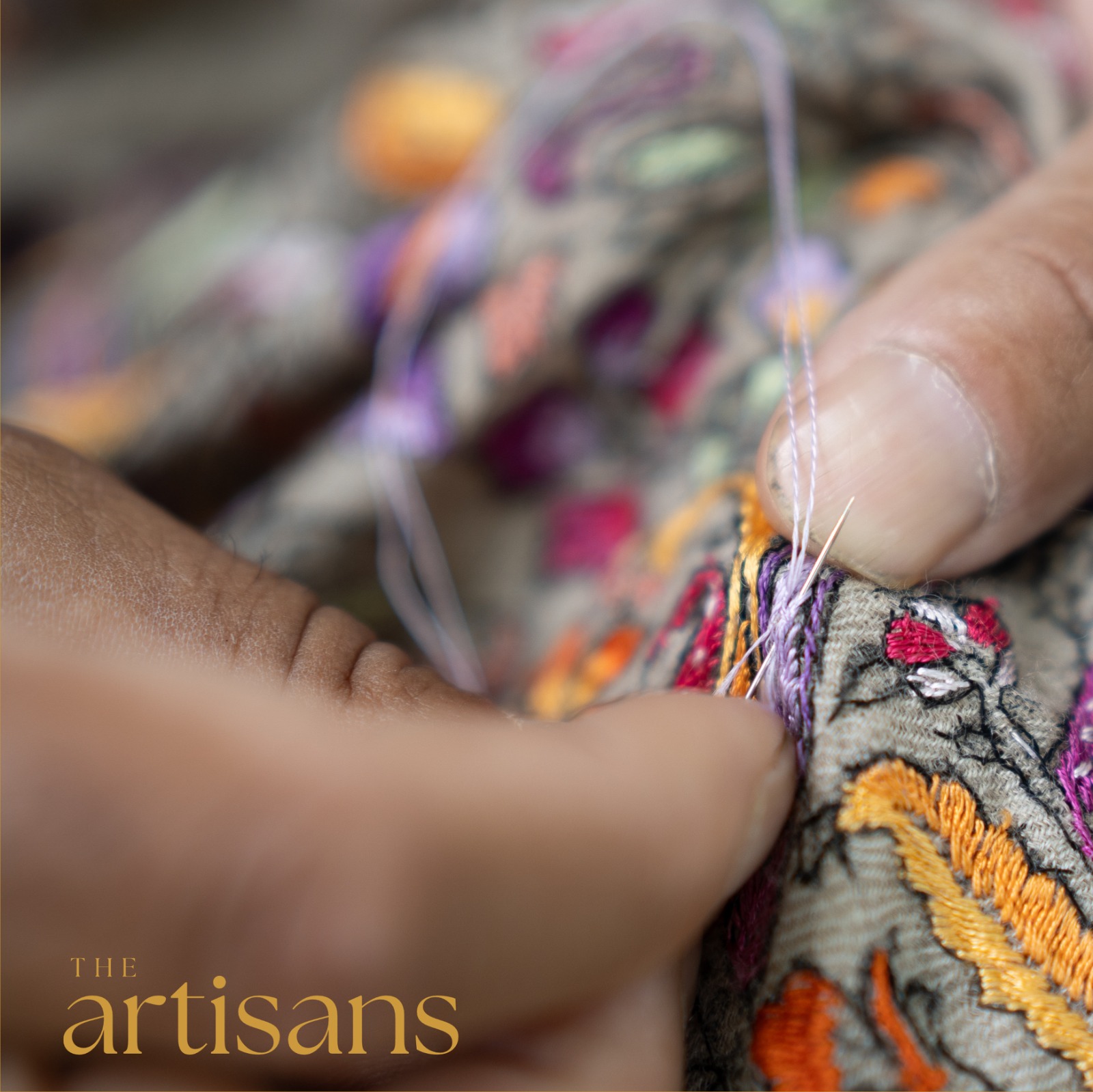
A skill is never simply “learned” in Kashmir. It is inherited, absorbed through years of watching, practicing, and slowly earning the trust of a master who has spent a lifetime perfecting a single skill, such as Sozni embroidery’s needle and thread poetry or Pashmina wool spinning’s patient handwork. This centuries-old system of teaching, known locally as the ustad shagird (master-disciple) tradition, is the reason Kashmiri handicrafts still carry the depth and precision they’re famous for today.
What Is the Tradition of the Ustad-Shagird?
Kashmir’s version of a craft apprenticeship is the ustad shagird relationship, but it goes deeper than a formal training program. An ustad a master craftsman takes on a shagird a student typically a young person from the same village or family line and instructs them through direct, hands-on practice rather than textbooks. The apprentice starts with the most basic tasks preparing thread, cleaning raw Pashmina wool, or simply observing the ustad’s hand movements for months before ever touching a needle or loom themselves.
This isn’t inefficiency it’s intention.Kashmiri artisans believe that patience is part of the skill itself. A shagird who rushes to embroider without first understanding the stitch’s rhythm will never achieve the fine control required for Tilla or Sozni work. How much time does it take to become a master craftsman? This is one of the most common questions we hear, so here’s a direct answer: mastering a craft like Pashmina shawl weaving or Sozni embroidery typically takes 6 to 10 years of consistent apprenticeship. Some skills, like intricate Jamawar weaving, can take even longer to refine.There is no shortcut in this tradition, as proficiency is measured by the ustad’s judgment rather than a calendar, unlike modern vocational courses with fixed timelines. Early years focus on:
Recognizing the texture, toughness, and quality of Pashmina fiber as raw materials Basic tool handling and hand movements Copying simple patterns under close supervision.
In later years, you learn: – Independent design work
Consistency and speed without sacrificing quality Teaching younger apprentices, which is itself considered proof of mastery
Why Is This System Still Used Today?
It would be easy to conclude that this time-honored method is fading in this day and age of online tutorials and instant certifications.It isn’t and there’s a practical reason why.Crafts like Sozni embroidery require thousands of tiny, hand-worked stitches that are so fine that they are frequently mistaken for those made by machines.A master must correct an apprentice’s hand position in real time, week after week, until muscle memory takes over, in order to achieve that level of precision.Families in regions like Srinagar’s old city and villages across the Kashmir Valley have passed these skills down for generations, often within the same household. A grandfather who knitted Pashmina shawls instructs his son, who then instructs his own children.This not only preserves the method, but also the cultural memory that is associated with it, such as the particular motifs, regional variations in stitch style, and the stories that go along with traditional patterns like the paisley (buta) or chinar leaf.
What Happens to This Tradition as Fewer Young People Join?
It’s an honest concern, and one artisan communities take seriously.Young Kashmiris are turning away from long-term apprenticeships in favor of faster-paying jobs.This has made skilled ustads more selective about who they train, and it’s increased the value both cultural and commercial of shawls and embroidery that are genuinely handmade by trained artisans rather than machine-replicated.
This matters directly to buyers. When you buy a genuine Pashmina shawl or a Kashmiri handicraft with hand-embroidered embroidery, you’re not just buying a textile you’re also supporting a training system that doesn’t have a backup plan from the institution. Sozni embroidery does not require a degree from a university. Knowledge does not enter a textbook if the apprenticeship chain breaks rather, it simply ceases.How can you tell a piece made by a machine from one made by a master craftsman? A few reliable signs
Slight irregularities in stitch spacing hand embroidery is precise but never mechanically uniform
The weight and softness of genuine Pashmina: hand-spun wool has a different drape than fiber that has been processed in a machine. Back of fabric detail hand-worked embroidery often shows clean, deliberate stitching on the reverse side too
These aren’t flaws. They’re proof of the years an artisan spent under an ustad’s guidance.
Carrying the Tradition Forward
Today’s Kashmiri artisans are all living links in a chain that dates back generations. When you buy a Kashmiri Pashmina shawl or a piece with authentic Sozni embroidery, you’re supporting artisans who learned their trade the old-fashioned way, not as a hobby but as a skill passed down from one generation to the next. This is the story behind every item we offer: not only is it fine craftsmanship, but it also represents a valuable training tradition.
Frequently Asked Questions
What is the ustad-shagird tradition in Kashmir?
The ustad-shagird tradition is Kashmir’s master-apprentice system of craft training, where an experienced artisan (ustad) personally teaches a student (shagird) skills like Pashmina weaving or Sozni embroidery through years of hands-on practice rather than formal classroom instruction.
How long does it take to become a skilled Kashmiri artisan?
It typically takes 6 to 10 years of consistent apprenticeship to master crafts like Sozni embroidery or Pashmina shawl weaving. More complex techniques, such as Jamawar weaving, can take even longer to fully learn.
Is Kashmiri embroidery done by hand or machine?
Authentic Sozni and Tilla embroidery is done entirely by hand. Genuine hand embroidery shows slight natural irregularities in stitch spacing and clean detailing on the reverse side of the fabric features that machine-made replicas typically lack.
Why is Pashmina apprenticeship training passed down within families?
Many Kashmiri artisan families pass skills from one generation to the next because the precision required such as hand-spinning Pashmina wool or executing fine embroidery stitches is best taught through direct, repeated correction from an experienced relative or master, not through written instruction.
How can I tell if a Pashmina shawl is genuinely handmade?
Look for a soft, uneven drape typical of hand-spun wool, slightly irregular embroidery stitching, and clean stitch work visible on the back of the fabric. Machine-made pieces tend to be too uniform and lack these subtle handmade characteristics.
Why does this apprenticeship system matter for buyers today?
Because there’s no institutional or academic alternative to this training if fewer young artisans enter these apprenticeships, techniques like Sozni embroidery risk disappearing. Buying authentically handmade Kashmiri crafts directly supports the continuation of this knowledge chain.